
What is aloe vera or aloe?
Today I want to introduce you, simply with a few lines, to the plant this blog is dedicated to: Aloe Vera.
THE PLANT
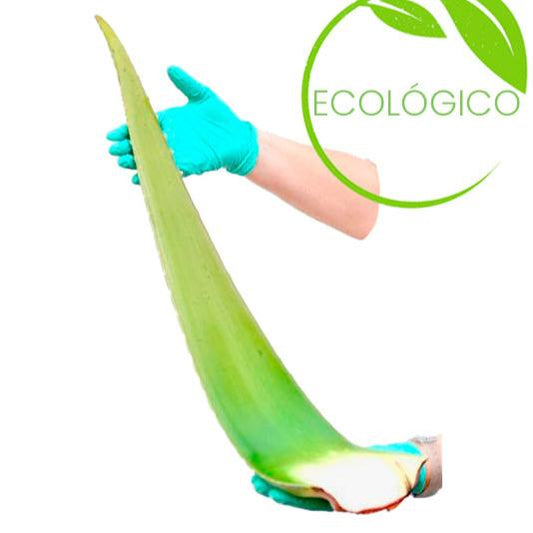
Aloe Vera, or Aloe Barbadensis Miller, or Sábila, is a plant that, although it may resemble cacti, belongs to the onion family; the Liliaceae. It is a green plant with a succulent appearance, perennial and xerophilous. The rhizome is long and the stem is short, around which a rosette of leaves is grouped. Its size can vary from 30 cm up to 3 m, depending on the variety. The flowers can be yellow, orange, purple, or red depending on the variety, and are 2.5 cm long.
It mainly grows in semi-arid regions of Africa, Asia, America, and Europe.
ITS ORIGIN
It is native to Africa, where there are more than 300 different species. It has been used for thousands of years in different cultures: Greece, Egypt, India, Mexico, China...
Queen Nefertiti and Cleopatra used Aloe Vera as a beauty product, and Alexander the Great and Christopher Columbus used it to heal the wounds of their crew.
CULTIVATION
Although aloe vera is capable of growing and developing in rocky and harsh terrain, its cultivation is recommended to be done in well-drained soil, since it is a plant from semi-desert climates.
The best type of soil to cultivate aloe is one with a slightly alkaline pH, as soil that is too acidic (with a pH of 8, for example) will cause slower and reduced plant growth. Its allies are the sun and mild climate, and it does not tolerate low temperatures or excess humidity.
ITS CONSTITUTION
We will dedicate many articles to the components of Aloe Vera, so for a first introduction, I will say that the most important part of this plant is contained in the transparent, colorless gelatinous mucilage, which occupies the largest internal volume of the leaf. This mucilage is the base of aloe gel used in various industries. On average, 98% of this gel by weight is water, and 2% or less are the remaining solid components of the aloe gel (more than 200 active components: enzymes, polysaccharides, anthraquinones, amino acids, vitamins, etc.), which make this plant fascinating.
Its secret is that we cannot consider each of its components separately, but rather the whole, with each part acting synergistically with the others and therefore essential to the final result.